Do humans have to live with bed bugs forever?

BED BUG
EXTINCTION?

We are investigating the deliberate worldwide extinction of the bed bug species responsible for human infestations.

We do not know if it is possible. No present research result demonstrates a safe, selective route to that outcome.

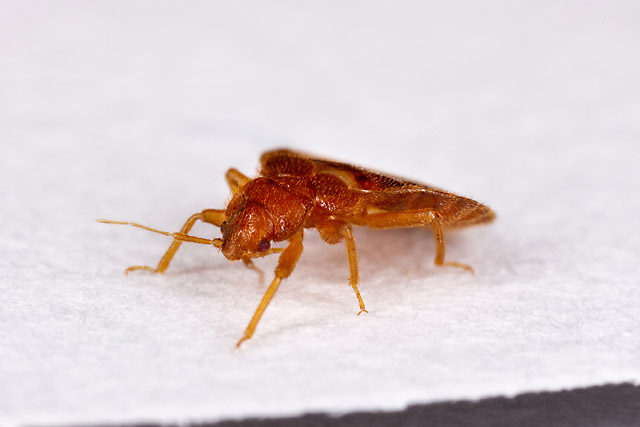
Side view of an adult Cimex lectularius bed bug on a light surface
Cimex lectularius, adult specimen. Photo by Stephen Ausmus, USDA Agricultural Research Service. Public domain. USDA ARS does not endorse this project.
THE CURRENT ANSWER: UNKNOWNWorldwide feasibility has not been demonstrated.Read the assessment →

We mean
extinction.

The literal disappearance of each target species worldwide. A clear apartment is relief. A clear city is a major public-health outcome. Neither is species extinction while fertile populations survive elsewhere.

The working target list is Cimex lectularius, C. hemipterus, and Leptocimex boueti. It must be revisited as taxonomy and host evidence improve.

Every independently sustaining population counts. That includes animal-associated populations. Bat-associated C. lectularius lineages have been documented; the status of other possible animal reservoirs is less certain. A human-only campaign would not satisfy the objective.

Species and reservoir evidence →

Why ask?

We are not researching better ways to live with bed bugs. We are researching whether humanity has to live with them at all.

Current responses are local and can require repeated effort when infestations persist or return. This project asks whether a permanent, species-level endpoint is scientifically and ethically possible. Its funding principle is equally explicit: affected households should not bear the cost of repeatedly solving a shared problem. No funding or free treatment service is established.

What we have learned

Research decisions as of 29 September 2026. These are assessments of evidence, not predictions of success.

QuestionCurrent assessmentWhy
Worldwide extinctionYELLOWUnresolved

The objective is defined. The project has not demonstrated that all target populations can be removed and their disappearance verified.

Reservoirs and global reachYELLOWUnresolved

No permanently unreachable sustaining class has been proved, but the occupied nonhuman universe and repeat detection remain unknown.

Contact plus lasting reproductive lossREDNot supported

The decisive viable-offspring effect in surviving secondary-contact recipients has not been measured; untouched refuges would remain.

Heritable or autonomous suppressionREDNot supported

No suppressive inherited system is demonstrated in the target species, and isolated populations cannot be reached through inheritance alone.

YELLOW means the question is open on current evidence. RED applies to the studied architecture as a credible global route today; it does not prove every conceivable approach impossible. How these decisions were reached →

12 BRANCHES. F03 DESK AUDIT COMPLETE.Dietary vitamins replaced several measured symbiont functions in C. lectularius laboratory work. A shared, non-substitutable nutritional function across all three target species remains unresolvable from existing desk evidence.SEE THE CURRENT FRONTIER ↗

FOLLOW THE
INVESTIGATION.

Every hard question gets a dated record. The latest decisions are here; the full log shows the tests and dead ends that led to them.

A shared nutritional weak point could not be decided at a desk

UNRESOLVABLE FROM EXISTING DESK EVIDENCE

Laboratory vitamin rescue weakens a simple universal symbiont claim, but three-species functional dependence remains unresolvable from existing desk evidence.

VIEW RECORD →

The frontier is mapped. The answer is still open.

YELLOW

Twelve meaningful branches were mapped without a demonstrated mission-killing barrier or an evidenced three-species extinction route; worldwide extinction stayed YELLOW.

VIEW RECORD →

The last refuge is still an open question

YELLOW

No permanently inaccessible sustaining class was demonstrated, but the occupied population universe and repeat reach remain unknown; global reach stayed YELLOW.

VIEW RECORD →
VIEW THE FULL RESEARCH LOG

What failed the test

A project this ambitious has to reject its own attractive ideas when the required evidence is absent.

CURRENT VERDICT: RED

Contact is not enough.

Transfer between bed bugs has been observed in laboratory work. But the lasting number of viable daughters produced by surviving, secondarily exposed females has not been established. Even a strong effect would leave an untreated sustaining refuge alive.

Read the contact finding →
CURRENT VERDICT: RED

Inheritance is not a shortcut.

No self-sustaining suppressive system has been demonstrated in these species. A hypothetical inherited effect could spread only through populations that actually exchange reproduction; it cannot jump a disconnected lineage.

Read the inheritance finding →

One surviving source is enough.

The project's connected-population model puts a number on the problem. Under one deliberately illustrative scenario, a reached human patch declines while an untreated refuge grows. The connected system therefore does not meet the extinction condition.

Read the model limits →
Illustrative C. lectularius model · daily growth multiplier, λ
Reached human patch0.924below 1 · declines
Untreated refuge1.053above 1 · grows
Connected system1.052above the extinction threshold

Values rounded from the project’s V2 scenario. Contact, kill, reproductive effect, and movement rates here are hypothetical, not measured field performance. A model threshold is not a treatment target.

What we still do not know

Where are all independently sustaining populations of the three target species?

Can low-density populations be found repeatedly in homes, farms, and animal roosts?

Could any intervention be safe, selective, lawful, and durable across every relevant population?

How would a worldwide absence claim be tested without mistaking nondetection for extinction?

Read the evidence.

The public research page separates field observations, conditional models, rejected mechanisms, and unresolved questions. It links claims to primary sources.

Open the research record

About / Contact

Operation Itchless Someday is a research initiative investigating a literal global bed bug extinction objective. It is not an extermination service, an active eradication campaign, or a claim that an intervention already exists.

Any future proposal would need independent safety and ecological review, public governance, lawful access, protection for tenants and affected communities, and a financing model that does not place treatment costs on households.